
5 layers of facial aging: Why skin quality and structural support need different approaches
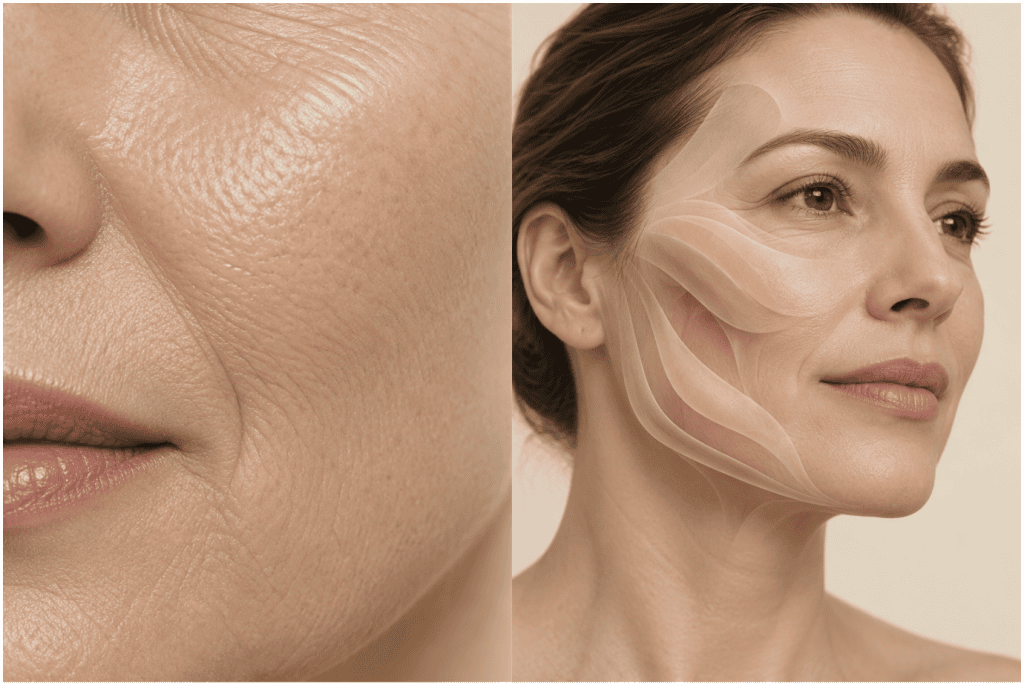
Facial ageing does not happen only in the skin. Changes can occur across the skin, superficial fat, facial muscles and connective tissue, deep fat, and the underlying bony framework.
Each layer contributes differently to wrinkles, hollows, folds, skin texture and changes in facial shape. This is why a treatment intended to improve pigmentation or surface texture cannot necessarily restore structural support—and why adding volume may not improve roughness, sun damage or skin quality.
What are the five layers of the face?
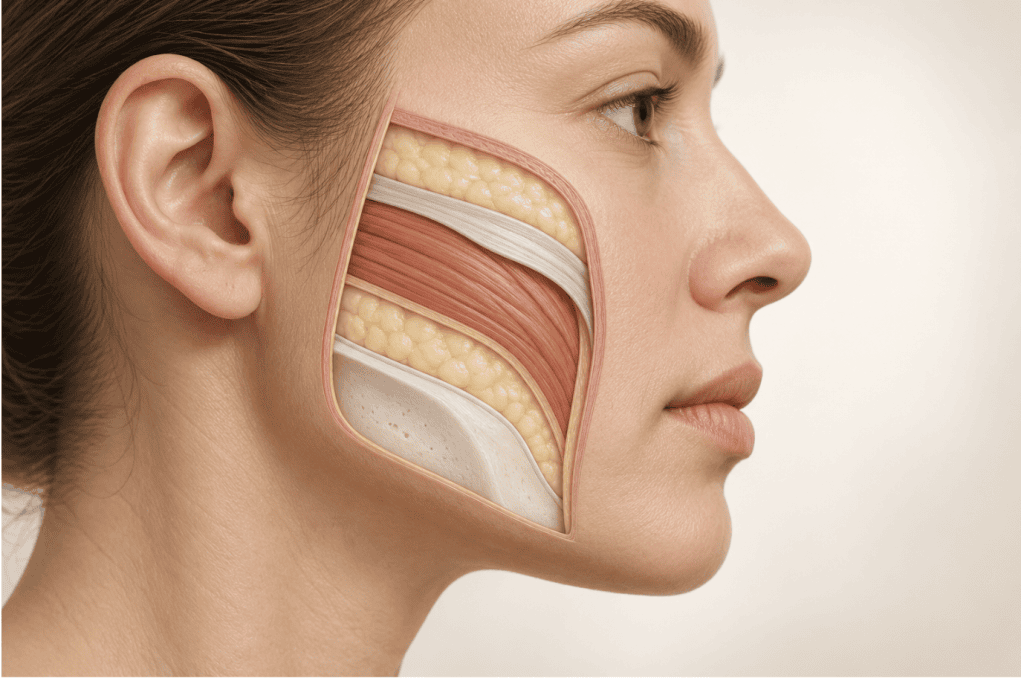
For educational purposes, facial anatomy can be described using five general layers:
- Skin
- Superficial fat and fibrous connections
- The superficial musculoaponeurotic system and facial muscles
- Deep fat and deeper supporting structures
- Periosteum, deep fascia and bone
This model helps explain why facial ageing is three-dimensional. However, the layers are not completely separate. Muscles, blood vessels, nerves and retaining structures interact with or pass through several levels.
Anatomical reviews commonly describe the face using these five tissue levels, while recognising that their arrangement varies across different facial areas.
Facial layer | Main role | Possible visible changes |
Skin | Surface protection, texture, colour and elasticity | Dryness, pigmentation, fine lines and rough texture |
Superficial fat | Softens contours and moves with expression | Folds, heaviness, deflation or changes in facial shape |
SMAS and muscle | Creates expression and transfers movement to the skin | Dynamic lines and changes in resting expression |
Deep fat and support | Provides projection and cushions deeper structures | Hollowing, flatter cheeks and stronger facial shadows |
Bone | Forms the underlying facial framework | Changes in projection, proportions and tissue support |
Layer 1: Skin
The skin is the visible surface of the face. It includes the epidermis and dermis, along with structures involved in pigmentation, hydration, collagen production and barrier function.
With age, the skin may become:
- thinner
- drier
- less elastic
- more uneven in colour
- rougher in texture
- more prone to fine lines
- slower to recover from irritation
Collagen and elastin help give the skin strength and flexibility. Their production and organisation change with age, while repeated ultraviolet exposure can accelerate visible damage.
In Australia, cumulative sun exposure is particularly relevant. Both UVA and UVB contribute to skin damage and premature ageing, including wrinkles and discolouration.
What does skin ageing look like?
Skin ageing may appear as:
- fine lines
- dullness
- enlarged or more visible pores
- dryness
- uneven pigmentation
- redness or visible vessels
- a rough or less reflective surface
These are primarily skin-quality concerns. They are different from a hollow caused by changes in deeper facial volume or bone.
What approaches may support skin quality?
Depending on the concern and skin type, an approach may include:
- daily sun protection
- gentle cleansing and moisturising
- selected topical ingredients
- treatment of pigmentation or redness
- chemical peels
- skin needling
- resurfacing or energy-based procedures
- collagen-stimulating procedures where suitable
No single approach is appropriate for every skin type. Pigmentation risk, sensitivity, medical history and expected downtime should be considered before professional treatment.
Layer 2: Superficial fat and fibrous connections
Beneath the skin sits a layer of superficial facial fat. This is not one continuous sheet. It is arranged in compartments separated by fibrous boundaries.
Superficial fat helps:
- soften the facial outline
- create smooth transitions between features
- move with facial expression
- support the overlying skin
With ageing, these compartments may change in volume, position and shape. One area may become flatter while another appears heavier or more prominent.
This helps explain why facial ageing does not always look like simple volume loss.
What do changes in superficial fat look like?
Visible changes may include:
- deeper folds
- altered cheek contours
- changes around the mouth
- heaviness through the lower face
- less definition along the jawline
- an uneven transition between neighbouring areas
Repeated movement, gravity, skin elasticity and changes in deeper structures may all influence what becomes visible at the surface.
Adding volume directly into every fold does not necessarily address these relationships. In some cases, the fold is the visible result of changes occurring elsewhere.
Layer 3: The SMAS and facial muscles
The superficial musculoaponeurotic system, commonly shortened to SMAS, is a connective layer associated with the muscles responsible for facial expression.
These muscles allow people to:
- smile
- frown
- blink
- raise the eyebrows
- purse the lips
- speak and communicate emotion
Because the skin, superficial fat and muscle layers are connected, muscle movement is transferred towards the skin.
How does muscle activity contribute to facial ageing?
Repeated expression can initially produce lines that are visible only during movement. Over time, some lines may remain visible when the face is at rest.
Examples include:
- forehead lines
- frown lines
- lines beside the eyes
- lines around the lips
- chin dimpling
- downward pull around the mouth
- vertical neck bands
Muscle ageing is not simply a matter of muscles becoming weaker. Changes in muscle tone, surrounding tissue resistance and the balance between different muscle groups can all influence facial expression.
Why a skin treatment cannot fully address muscle movement
A skin treatment may improve texture or fine surface lines, but it does not necessarily change the repetitive movement producing a dynamic line.
Similarly, a muscle-focused treatment will not correct pigmentation, dryness or rough skin.
When both factors are involved, they need to be identified separately rather than expecting one treatment to address every layer.
Layer 4: Deep fat and deeper supporting structures
Deep facial fat sits beneath the muscle layer in several important areas. It provides projection, cushions movement and helps support smooth transitions across the face.
Areas influenced by deep support include:
- the temples
- the under-eye-to-cheek transition
- the central and lateral cheeks
- the area beside the nose
- the chin and lower face
Deep fat compartments may gradually lose volume or change in shape. When this occurs, the overlying tissues may have less support.
The result may be:
- under-eye hollowing
- flatter cheeks
- stronger shadows
- deeper facial transitions
- changes in lower-face contours
- a more angular or less supported appearance
Where do facial ligaments fit?
Facial retaining ligaments and related fibrous structures connect deeper tissues to more superficial layers. They help organise facial compartments and provide points of attachment.
They should not be described as a single separate horizontal layer. Some extend between several anatomical levels.
It is also an oversimplification to say that a non-surgical treatment directly “tightens the ligaments”. A treatment may alter volume, tissue quality or mechanical support around particular areas, but it does not simply return every ligament to an earlier state.
Layer 5: Periosteum, deep fascia and bone
At the deepest level, the periosteum covers the facial bones. The facial skeleton provides the framework supporting the soft tissues above it.
Bone is not static throughout adulthood. Gradual remodelling can occur around areas including:
- the eye sockets
- the upper and lower jaw
- the midface
- the nasal opening
- the chin
- the area in front of the jowl
These changes are regional rather than uniform. The orbital rims, maxilla and mandible may change in different ways and at different rates.
How can bone changes affect the visible face?
When the underlying framework changes, the position and projection of overlying tissues may also appear different.
This may contribute to:
- a more visible under-eye hollow
- reduced cheek projection
- changes around the nose and mouth
- altered chin or jaw contours
- less support through the lower face
Skincare cannot replace changes in the skeletal framework. At the same time, adding support above the bone does not reverse the biological process of bone remodelling.
This distinction is important when discussing realistic treatment expectations.
Why do the layers age at different rates?
Facial ageing is not identical for every person. The speed and pattern of change can be influenced by:
- genetics
- ethnicity
- facial anatomy
- sun exposure
- smoking
- skin condition
- hormones
- significant weight change
- repeated facial movement
- health conditions
- previous treatments
- lifestyle and environmental exposure
One person may have significant sun-related pigmentation with relatively good facial volume. Another may have smooth skin but notice changes in the cheeks, temples or jawline.
Research comparing Australian women with women in other countries has also found differences in reported skin and volume-related signs of facial ageing, highlighting the importance of environmental exposure and individual variation.
There is no fixed age at which each layer begins to change visibly.
Why skin quality and structural support need different approaches
Skin quality and facial structure can influence one another visually, but they are not the same concern.
Skin-quality concerns
These include:
- pigmentation
- redness
- dryness
- rough texture
- fine surface lines
- reduced radiance
- enlarged pores
Approaches usually focus on the surface and dermal layers.
Muscle-related concerns
These include:
- expression lines
- a heavy-looking brow
- chin dimpling
- strong downward pull around the mouth
- jaw or lower-face muscle activity
Approaches need to consider movement and the balance between neighbouring muscles.
Structural concerns
These may include:
- under-eye or temple hollowing
- reduced cheek projection
- altered facial proportions
- changes in the chin or jawline
- deeper shadows caused by loss of support
Approaches may involve treatments intended to influence projection, volume or deeper support. Surgery may be more appropriate where tissue repositioning or significant laxity is the main concern.
Mixed concerns
Many people have changes involving more than one layer.
For example, an under-eye concern may involve:
- thin or pigmented skin
- muscle visibility
- a natural tear trough
- changes in deep cheek support
- the shape of the eye socket
Treating only the darkest point may not address all of these contributors.
Why treating the skin alone has limitations
Skincare and professional skin treatments can improve concerns such as pigmentation, texture, dryness and some fine lines.
They cannot substantially restore:
- lost cheek projection
- changes in facial bone
- deep volume loss
- significant tissue descent
- an anatomical hollow
This does not make skin treatment unimportant. Improving surface quality can change how evenly light reflects from the face and may provide a meaningful improvement without altering facial shape.
The limitation arises when a structural concern is treated as though it were only a skin concern.
Why structural treatment alone has limitations
A structurally focused treatment may change projection or reduce a shadow, but it will not necessarily improve:
- sun damage
- rough texture
- persistent redness
- melasma
- acne scarring
- dehydration
- poor skin-barrier function
Adding more structural support will not make unhealthy or sun-damaged skin behave like healthy skin.
Excessive or poorly selected treatment can also create heaviness, overprojection or an imbalance with untreated areas. More treatment does not automatically produce a better or more natural result.
Where do collagen-stimulating approaches fit?
Collagen-stimulating approaches are often discussed in relation to skin quality, firmness and broader tissue support.
Their effects generally develop gradually and depend on the person’s biological response. Different treatments vary in their mechanisms, suitability, evidence and risk profiles.
A systematic review found growing interest in biostimulatory approaches for facial rejuvenation but also identified variation in the products, treatment methods and available studies.
These treatments should not be presented as:
- replacing facial bone
- restoring every fat compartment
- tightening all facial ligaments
- producing the same response in every patient
- stopping the ageing process
They may form one part of a broader plan when clinically appropriate.
Does a whole-face approach mean treating every layer?
No. A whole-face approach means assessing every relevant layer, not treating all of them.
A consultation may conclude that:
- skincare and sun protection are the main priorities
- one skin concern should be addressed first
- facial movement is contributing to the concern
- structural support should be assessed
- treatment should be staged
- referral for another medical, dental or surgical opinion is appropriate
- no treatment is currently needed
A conservative plan identifies the layer most responsible for the concern and begins with the approach most likely to provide a meaningful benefit.
What does a layered facial assessment involve?
A practitioner may assess:
- the skin’s colour, texture and thickness
- facial contours from the front, side and three-quarter views
- areas of light and shadow
- facial movement and resting expression
- superficial and deeper volume patterns
- symmetry and natural proportions
- previous procedures
- medical history and medicines
- dental or jaw factors
- the patient’s priorities and expectations
Standardised photographs may help document the face at rest and during expression.
A proper assessment should also explain which changes cannot be corrected by the proposed treatment.
Can facial ageing be prevented?
Facial ageing cannot be stopped, but some preventable factors can be reduced.
Helpful measures include:
- using sun protection when required
- avoiding smoking
- following a suitable skincare routine
- treating inflammatory skin conditions
- avoiding intentional tanning
- maintaining a generally stable weight
- supporting overall health
- seeking qualified advice before cosmetic procedures
Sun protection remains particularly important in Australia because UV exposure contributes to premature skin ageing as well as skin cancer risk.
These measures mainly support the skin and general health. They cannot completely prevent age-related changes in fat, muscle or bone.
Frequently asked questions
Can skincare restore lost facial volume?
No. Skincare may improve hydration, pigmentation, texture and some fine lines, but it cannot significantly replace deeper facial volume or alter the underlying bone.
Do all five facial layers age at the same rate?
No. Each layer changes differently, and the pattern varies between individuals. Someone may experience visible skin damage before structural change, while another person may notice hollowing despite relatively smooth skin.
Why can my face look less supported when my skin is still good?
Changes in deep fat, facial bone or tissue distribution can alter projection and create shadows even when the skin remains smooth and relatively even.
Can a treatment tighten the facial ligaments?
This description is usually too simplistic. Treatments may affect tissue volume, collagen response or mechanical support around particular regions, but they do not necessarily restore every retaining ligament to its earlier state.
Are collagen-stimulating treatments the same as volumising treatments?
Not necessarily. Collagen-stimulating approaches are intended to produce a gradual tissue response, while other treatments may be used primarily to create immediate projection or support. Their suitability, effects and risks differ.
Does a layered approach require more procedures?
No. It may help avoid unnecessary procedures by identifying which layer is most responsible for the concern. In some cases, one focused approach—or no treatment—may be recommended.
Understanding the face from skin to structure
Facial ageing is a combined process involving the skin, fat compartments, connective structures, muscles and underlying bone.
A fine line caused mainly by repeated movement requires a different assessment from pigmentation, rough skin or a hollow created by reduced structural support. Treating all of these concerns in the same way is unlikely to provide a balanced result.
MAEC provides doctor-led consultations in Bulleen for patients across Melbourne and the eastern suburbs. A personalised facial assessment can help identify which layers are contributing to a concern, which approaches may be suitable and what limitations or risks should be considered before proceeding.
References
- Better Health Channel – Healthy ageing and the skin
- Cancer Council Australia – Sunscreen basics
- Journal of the German Society of Dermatology – Anatomy of the facial fat compartments and their relevance in aesthetic surgery
- Aesthetic Surgery Journal – The facial ageing process from the inside out
- Journal of Craniofacial Surgery – Facial bone ageing: An update and literature review
- Australasian Journal of Dermatology – Comparison of self-reported signs of facial ageing among women in Australia, the USA, the UK and Canada
- Journal of Plastic, Reconstructive & Aesthetic Surgery – The emerging role of biostimulators as an adjunct in facial rejuvenation: A systematic review
Leave a Reply