


What Is Melasma? Causes, Signs and Why It Keeps Coming Back
Melasma is a common pigmentation condition that causes flat, irregular patches of brown or grey-brown colour, usually on the face. It often appears across the cheeks, forehead, nose or upper lip and may become more noticeable following sun exposure or hormonal changes.
Although melasma is not usually painful or harmful, it can be persistent. The pigment may improve and then darken again, particularly when the skin is exposed to recurring triggers. Understanding what melasma is—and confirming that the pigmentation is actually melasma—is an important first step towards managing it appropriately.
Understanding melasma at a glance
Melasma develops when pigment-producing cells called melanocytes become overactive and produce more melanin than usual.
Melanin gives the skin its natural colour. When excess melanin collects in certain areas, it creates the uneven patches associated with melasma.
A few important things to understand are:
- Melasma most commonly appears on the face.
- The patches are usually flat rather than raised.
- It often affects both sides of the face in a similar pattern.
- Sun exposure and hormonal changes are common triggers.
- It is more common in women but can also affect men.
- It can affect people of any skin tone, although it is more frequently seen in people who tan easily or have naturally medium to darker skin.
- It is usually a long-term condition that may improve and recur.
Melasma is not contagious, and it does not develop because the skin is unclean. However, it can look similar to several other forms of pigmentation, which is why assessment matters before beginning treatment.
What does melasma look like?
Melasma usually appears as patchy areas of light brown, tan, dark brown or occasionally grey-brown pigmentation. The borders may be irregular, but the pigmentation often follows a recognisable pattern.
The most commonly affected areas include:
- The forehead
- The cheeks
- The bridge of the nose
- The skin above the upper lip
- The chin or jawline
Less commonly, melasma may appear on other sun-exposed areas, such as the forearms.
Melasma itself is generally smooth and does not normally cause scaling, pain or itching. If an area of pigmentation becomes raised, sore, itchy, crusted, bleeds or changes quickly, it should be assessed by a qualified medical practitioner rather than assumed to be melasma.
What causes melasma?
There is rarely one single cause. Melasma is better understood as a condition that develops when someone with pigment-sensitive skin encounters one or more triggers.
Sun and visible-light exposure

Ultraviolet radiation stimulates melanocytes to produce more pigment. This is why melasma often becomes darker during warmer and sunnier months or after time spent outdoors without adequate protection.
Visible light may also contribute to pigmentation in people with melasma. This includes the light we can see from the sun, rather than ultraviolet radiation alone.
In Australia’s high-UV environment, sun protection is therefore not simply an aftercare step. It is a central part of reducing repeated pigment stimulation.
Hormonal changes
Melasma is closely associated with hormonal changes. It commonly appears during pregnancy, which is why it has sometimes been called the “mask of pregnancy”.
Other potential hormonal influences may include:
- Oral contraceptive use
- Hormonal intrauterine devices or implants
- Hormone replacement therapy
- Changes that occur during different reproductive stages
A hormonal association does not mean that every person with melasma has a hormonal imbalance. Hormones may be one part of a broader picture that also includes genetics and light exposure.
People should not stop prescribed medication or contraception without first speaking with their doctor.
Genetics and family history
Some people are naturally more likely to develop melasma. A family history of similar facial pigmentation is common, suggesting that genetics can influence how readily the skin produces pigment.
Melasma is also seen more frequently in people with skin that tans easily. However, it can occur across different skin tones and backgrounds.
Skin irritation and inappropriate treatment
Melasma is sometimes mistaken for a surface-level dark spot that simply needs to be removed. This can lead people to use strong acids, abrasive scrubs or multiple active skincare ingredients without appropriate guidance.
Irritation does not necessarily cause melasma itself, but inflammation can make facial pigmentation appear more noticeable and may lead to additional post-inflammatory pigmentation.
This is one reason treating skin without first establishing a diagnosis can produce disappointing or unpredictable results.
Why does melasma keep coming back?
Melasma frequently returns because the skin’s tendency to produce excess pigment does not always disappear when the visible patches fade.
Several factors can contribute to recurrence.
The original triggers may still be present
Sunlight, visible light and hormonal influences can continue stimulating pigment-producing cells. Even after the skin appears clearer, renewed exposure may cause the patches to darken again.
Pigment can sit at different depths
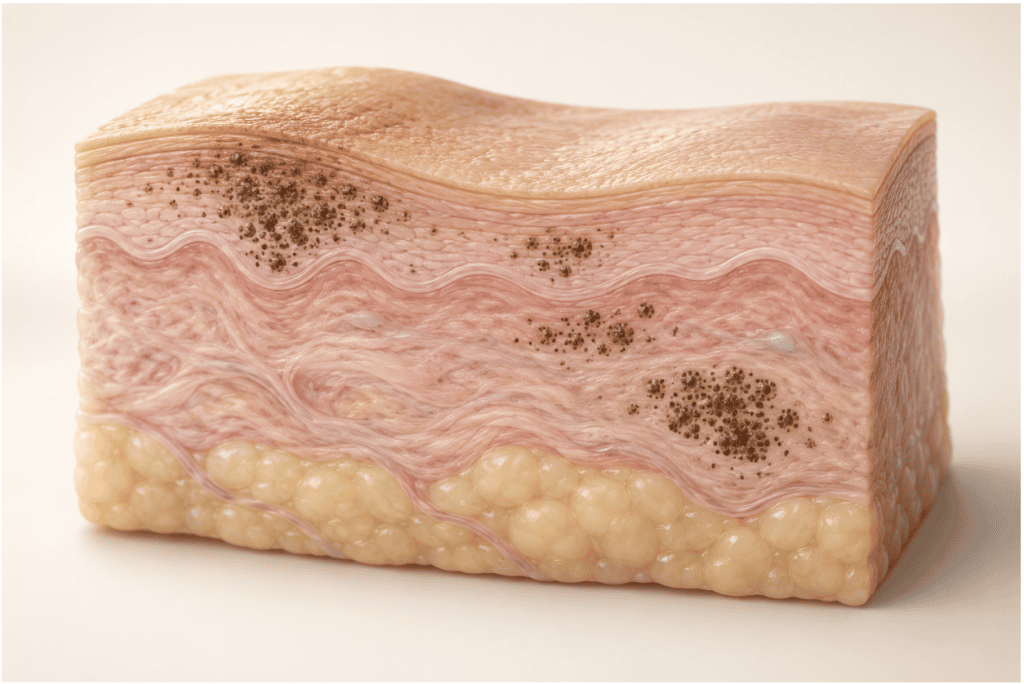
Melasma pigment may be located in the more superficial epidermal layer, the deeper dermal layer or a combination of both.
Superficial pigment may respond more readily to treatment than deeper or mixed pigmentation. This difference cannot always be identified simply by looking in the mirror and may influence which management options are considered.
Improvement does not always mean permanent clearance
Melasma is generally approached as a condition that requires ongoing management rather than a problem that can always be permanently removed.
Some people experience significant improvement, while others retain some visible pigmentation. Results may also change over time as the skin encounters new hormonal, environmental or lifestyle influences.
Treatment that is too aggressive may aggravate the skin
More intensive treatment is not automatically better. Some lasers, light-based devices or strong peels can aggravate melasma when they are unsuitable for the person’s skin type, pigment depth or current skin condition.
Australian dermatology guidance notes that laser and light-based treatments may be considered in selected, treatment-resistant cases, but their benefits can be unpredictable and there is a risk of worsening pigmentation.
A measured, staged plan is generally more appropriate than attempting to remove all pigment as quickly as possible.
Is melasma the same as other facial pigmentation?
Melasma is one type of hyperpigmentation, but not every dark patch is melasma.
Pigmentation concern | Common appearance |
Melasma | Blotchy, flat patches that commonly appear across both cheeks, the forehead, nose or upper lip |
Sunspots | More defined individual spots on areas with a history of sun exposure |
Post-inflammatory pigmentation | Dark marks that remain after acne, irritation, injury or inflammation |
Freckles | Smaller spots that are often influenced by genetics and become darker with sun exposure |
These conditions can occur together. Someone may have melasma across the cheeks as well as individual sunspots or pigmentation left behind by acne.
Because the underlying causes differ, the same treatment will not necessarily be suitable for every type of pigmentation.
How is melasma diagnosed?
Melasma is often diagnosed by examining the colour, location and distribution of the pigmentation.
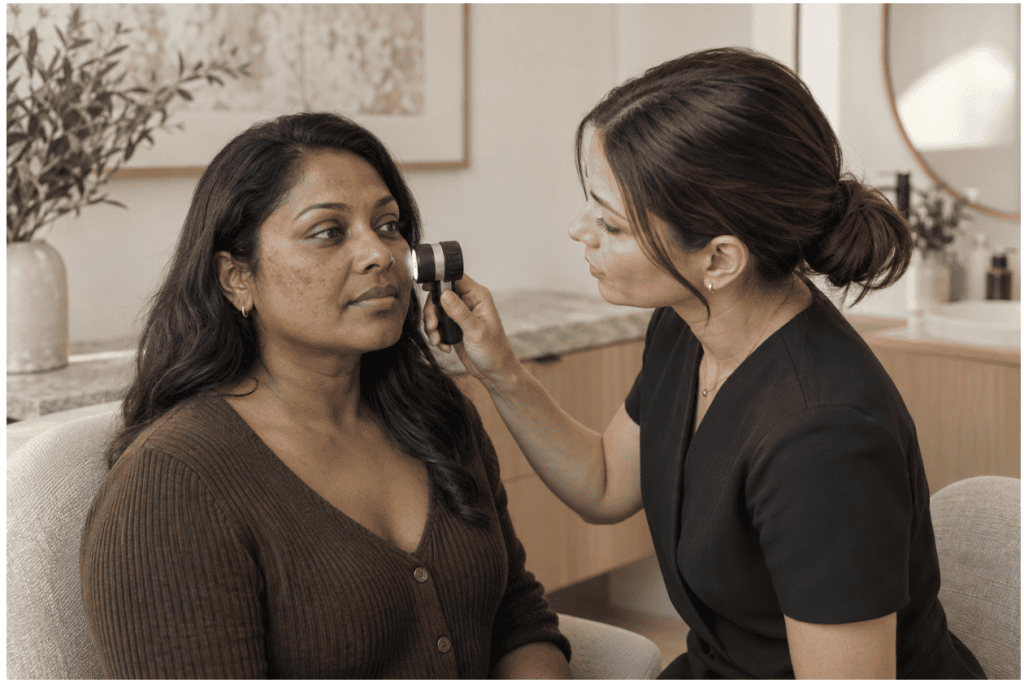
A practitioner may also ask about:
- When the pigmentation first appeared
- Pregnancy or hormonal changes
- Contraceptive or medication use
- Sun exposure
- Previous skincare and treatments
- Family history of pigmentation
- Whether the patches change with the seasons
A dermatoscope—a specialised magnifying device—may be used to examine the pigment more closely. In some situations, further medical assessment may be recommended to exclude other skin conditions.
At MAEC, consultation and skin assessment help establish a clearer baseline before a treatment plan is considered. This is especially important for pigmentation because what looks similar on the surface may have a different cause or depth within the skin.
Can melasma be prevented from becoming darker?
It may not always be possible to prevent melasma entirely, particularly when genetics or hormones are involved. However, reducing known triggers can help limit repeated darkening.
Helpful measures may include:
- Wearing broad-spectrum SPF 50 or SPF 50+ sunscreen daily
- Applying enough sunscreen and reapplying when required
- Using a broad-brimmed hat, shade and protective clothing
- Avoiding unnecessary irritation from harsh scrubs or excessive active ingredients
- Following appropriate skincare advice rather than frequently changing products
- Discussing possible hormonal influences with a medical practitioner
- Maintaining a long-term plan after visible improvement
The Australasian College of Dermatologists recommends broad-spectrum, water-resistant SPF 50 or SPF 50+ sunscreen and notes that iron oxide-containing formulas may be helpful for melasma. Sunscreen should still be combined with other forms of sun protection rather than treated as the only protective measure.
What treatment options may be considered?
Melasma treatment should be personalised. The most appropriate approach depends on the depth and pattern of pigmentation, skin type, possible triggers, previous treatments and sensitivity of the skin.
Depending on the individual, a management plan may involve:
- Consistent sun and visible-light protection
- A simplified home skincare routine
- Practitioner-recommended topical treatments
- Selected chemical peels
- Carefully considered energy-based treatment
- Ongoing maintenance and review
Some topical and oral options require medical assessment and may not be suitable during pregnancy, breastfeeding or alongside certain health conditions or medications.
Procedures also require careful selection. Treating the skin too aggressively can create inflammation, which may make pigmentation more difficult to manage.
MAEC’s skin rejuvenation and skin health programs follow a consultation-led approach, allowing treatment decisions to be based on the individual’s skin rather than on pigmentation alone.
Setting Realistic Expectations
Melasma can often be improved, but complete and permanent clearance cannot be guaranteed. Even when pigmentation becomes less visible, ongoing protection and maintenance may be needed to reduce recurrence.
Pregnancy-associated melasma may gradually fade after pregnancy, although it can return during later pregnancies or with renewed sun exposure. Other forms may remain visible for longer.
A realistic goal is usually to improve the appearance of the pigmentation, identify avoidable triggers and develop a routine that supports more stable results over time.
Frequently asked questions about melasma
Is melasma harmful?
Melasma is usually a benign pigmentation condition and does not normally cause physical discomfort. However, pigmentation that is new, changing or difficult to identify should be professionally assessed.
Can men develop melasma?
Yes. Although melasma is more commonly seen in women, men can also develop it. Sun exposure, genetics, skin type and other factors may contribute.
Does melasma disappear on its own?
Some pregnancy-associated melasma may fade gradually after delivery. However, melasma can persist or return, especially when the skin is exposed to sunlight or other ongoing triggers.
Will sunscreen remove existing melasma?
Sunscreen does not directly remove existing pigment. It helps reduce further stimulation from ultraviolet radiation and supports the effectiveness of other management measures.
Can laser treatment remove melasma permanently?
Laser and light-based treatments do not guarantee permanent removal. Inappropriately selected treatment can sometimes worsen melasma, so suitability should be assessed carefully.
How do I know whether I have melasma or sunspots?
Melasma often forms broader, more symmetrical patches, while sunspots tend to appear as separate, well-defined marks. However, they can look similar or occur together, so an in-person skin assessment is more reliable than self-diagnosis.
A considered approach to facial pigmentation
Melasma is influenced by more than the pigment visible on the surface. Hormones, genetics, sun exposure, pigment depth and previous treatment can all affect how it behaves.
For this reason, effective care begins with understanding the skin rather than immediately choosing a procedure. If you are concerned about facial pigmentation, a professional assessment can help determine whether it is melasma and explain which options may be appropriate for your skin.
MAEC provides doctor-led skin consultations in Bulleen, Melbourne, with an emphasis on careful assessment, patient education and personalised planning. Book a consultation to discuss your concerns with the clinical team.
Leave a Reply